IELTS Writing Task 1 · Bar chart

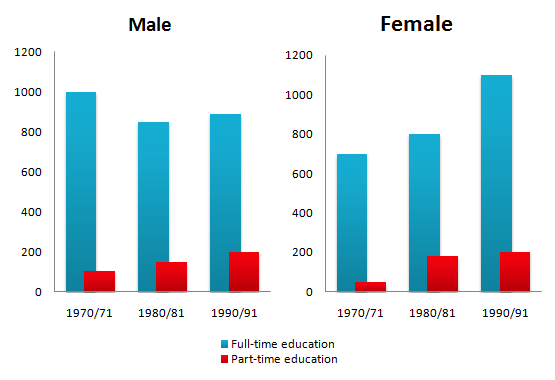
Bài mẫu IELTS Writing Task 1: The chart below shows the number of men and women in further education in Britain in three periods and whether they were studying fulltime or part-time.

Biểu đồ cột 20 phút · tối thiểu 150 từ Bài mẫu 6.0 Bài mẫu 7.0 Bài mẫu 9.0 trong app

Đề bài

The chart below shows the number of men and women in further education in Britain in three periods and whether they were studying fulltime or part-time.

Summarise the information by selecting and reporting the main features, and make comparisons where relevant.

IELTS Writing Task 1 Bar chart: The chart below shows the number of men and women in further… Viết ít nhất 150 từ trong khoảng 20 phút.

Dàn ý gợi ý cho dạng Bar chart

Xem tất cả đề dạng Bar chart →

Biểu đồ cột so sánh số liệu giữa các nhóm, đôi khi qua nhiều mốc thời gian. Điểm mấu chốt là nhóm số liệu để so sánh, không mô tả từng cột.

  1. Mở bàiParaphrase đề: biểu đồ cho thấy gì, ở đâu, khi nào. Không chép nguyên câu đề.
  2. Overview2 câu nêu đặc điểm nổi bật nhất: nhóm cao nhất/thấp nhất, xu hướng chung. Không đưa số liệu chi tiết.
  3. Thân bài 1Nhóm các cột có điểm chung (cùng tăng, cùng cao…), so sánh kèm số liệu cụ thể.
  4. Thân bài 2Nhóm còn lại hoặc các điểm ngoại lệ, tiếp tục so sánh bằng số liệu.
  • Dùng cấu trúc so sánh: higher than, twice as many as, the largest proportion of.
  • Mỗi đoạn thân bài nên có 3–4 số liệu, đừng liệt kê hết.
  • Chú ý đơn vị: %, million, tonnes.

Bài mẫu band 6.0

172 từ. Bài đủ ý, bố cục rõ, từ vựng và ngữ pháp ở mức an toàn: đây là mức nhiều bạn cần để đạt mục tiêu 6.0.

The bar charts show the number of men and women in further education in Britain in 1970/71, 1980/81 and 1990/91, and whether they studied full-time or part-time.

Overall, most students studied full-time in all three periods. The number of female full-time students increased a lot, while the number of male full-time students decreased slightly. Part-time students increased for both men and women.

For men, there were about 1,000 full-time students in 1970/71. This number fell to about 850 in 1980/81, and then it rose slightly to about 890 in 1990/91. The number of male part-time students increased steadily from 100 to 150 and then to 200.

For women, there were about 700 full-time students in 1970/71, which was lower than men. However, the number increased to 800 in 1980/81 and 1,100 in 1990/91, so women had more full-time students than men in the last period. Female part-time students also increased a lot, from only 50 in 1970/71 to about 180 in 1980/81 and 200 in 1990/91, which was the same as men.

Bài mẫu band 7.0

178 từ. So với bài 6.0: lập luận sâu hơn, từ vựng chính xác và đa dạng hơn, câu phức dùng tự nhiên hơn.

The bar charts compare the numbers of men and women in further education in Britain in three periods, divided into full-time and part-time study.

Overall, full-time study was much more common than part-time study for both sexes throughout. The most notable change was the substantial growth in the number of women studying full-time, which overtook the number of men by 1990/91. Part-time study increased steadily for both genders.

Còn 2 đoạn của bài 7.0 và bài mẫu band 9.0

Đăng nhập miễn phí để đọc trọn bài, so sánh 3 mức band và viết thử ngay trên đề này.

Đọc tiếp trong app